
wellortho@welltrusttech.com
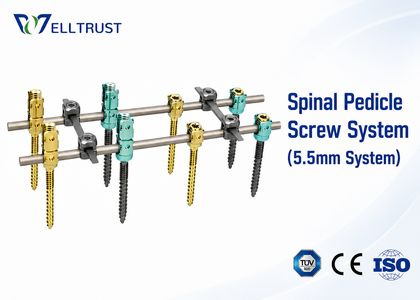
Spinal fixation systems are designed to provide mechanical support and stabilization of the spine during specific surgical procedures. Among the commonly used posterior fixation configurations, a Spinal Pedicle Screw System combines pedicle screws, rods and connecting components into an integrated construct. Different screw designs can provide different degrees of positioning flexibility and are selected according to the surgical plan and anatomical requirements.
The 5.5mm Spinal Pedicle Screw System is one configuration used for spinal fixation applications. It includes monoaxial and polyaxial pedicle screws, reduction screws, rods and crosslinks. Understanding the function of each component helps medical device distributors and professional users evaluate the configuration of a spinal fixation system.
The basic principle of a Spinal Pedicle Screw System is to connect selected vertebral structures with a mechanically supportive construct. Pedicle screws are positioned within the vertebral pedicles according to the surgical plan. The screw heads provide connection points for longitudinal rods, which are then secured to the screws.
The rods connect multiple fixation points and form the main longitudinal structure of the construct. Depending on the system design, crosslinks can be added between the rods to provide an additional transverse connection.
Reduction screws can provide additional rod-seating or reduction functionality during the surgical procedure. The specific use of each component depends on the surgical technique and the design of the fixation system.
Pedicle Screws: Pedicle screws are the primary fixation components of the system. They are available in different configurations and dimensions to accommodate different surgical requirements.
Rods: Rods connect the screw assemblies along the spinal fixation construct. The system shown includes 5.5mm rods with several available lengths.
Crosslinks: A crosslink connects the two longitudinal rods transversely. Different crosslink lengths can be selected according to the configuration of the fixation construct.
Reduction Screws: Reduction screws incorporate a screw-head configuration designed to facilitate rod positioning and reduction during assembly. Both monoaxial and polyaxial reduction screw options are available in this product range.
One of the main design differences within a Spinal Pedicle Screw System is the screw-head configuration.
Monoaxial Pedicle Screw: A monoaxial screw has a fixed relationship between the screw shaft and screw head. This configuration provides a defined orientation between the screw and the connecting rod.
Polyaxial Pedicle Screw: A polyaxial screw allows the screw head to move relative to the screw shaft within its designed range. This provides additional flexibility when aligning the screw head with the rod during construct assembly.
The choice between monoaxial and polyaxial configurations depends on the surgical technique, fixation strategy and requirements of the individual case.
Reduction screws are designed to support rod placement and reduction during assembly of the spinal fixation construct. The Well Trust 5.5mm system includes both Monoaxial Reduction Screw and Polyaxial Reduction Screw configurations.
The monoaxial reduction screw maintains a fixed screw-head orientation, while the polyaxial configuration provides greater angular flexibility between the screw shaft and head. These different configurations allow the system to accommodate different construct designs and surgical approaches.
The rod is an important structural component of the Spinal Pedicle Screw System. The Well Trust 5.5mm system includes rods with several available lengths, including 100mm, 150mm, 200mm, 250mm, 300mm, 350mm, 400mm, 500mm and 600mm.
The system also includes 5.5mm crosslinks in three available lengths: 60mm, 70mm and 80mm. The appropriate rod and crosslink dimensions depend on the planned construct and the corresponding screw positions.
The 5.5mm system provides multiple screw diameters and lengths. The listed monoaxial pedicle screw configurations include diameters from approximately 5.0mm to 7.0mm, with different lengths such as 30mm, 35mm, 40mm, 45mm and 50mm.
The polyaxial pedicle screw range provides additional configurations, including approximately 4.5mm, 5.0mm, 5.5mm, 6.0mm, 6.5mm and 7.0mm diameters with different screw lengths. Reduction screw configurations are also available in several diameter and length combinations.
These specifications provide different options for configuring a spinal fixation system. The exact implant size and configuration should be selected according to the patient's anatomy, surgical plan and the applicable surgical technique.
Well Trust supplies orthopedic surgical instruments and implant-related products for professional medical applications. Its 5.5mm Spinal Pedicle Screw System includes multiple screw configurations together with rods and crosslinks.
The product range includes 5.5mm monoaxial pedicle screws, monoaxial reduction screws, polyaxial pedicle screws and polyaxial reduction screws. The system is complemented by 5.5mm rods in multiple lengths and crosslinks in 60mm, 70mm and 80mm configurations.
For medical device distributors and professional customers, the availability of different screw diameters, lengths and head configurations allows the product range to accommodate different fixation requirements. Product codes and detailed specifications can be reviewed when determining the appropriate system configuration.
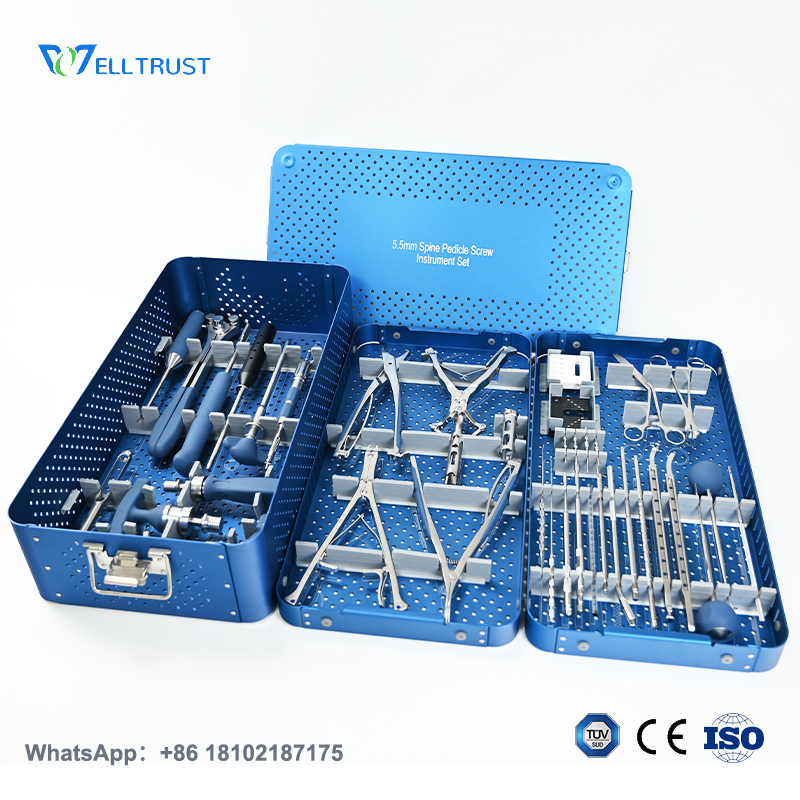
Several factors should be considered when evaluating a Spinal Pedicle Screw System. These include screw diameter, screw length, monoaxial or polyaxial configuration, reduction capability, rod diameter and rod length.
Compatibility between screws, rods, crosslinks and associated instruments is also important. The complete system should be evaluated as an integrated construct rather than selecting individual components independently.
For distributors, clearly defined product models and specifications can also simplify inventory management and product selection for different spinal fixation requirements.
A Spinal Pedicle Screw System is a group of spinal fixation components that typically includes pedicle screws, rods and connecting accessories. The components are assembled to create a planned spinal fixation construct.
A monoaxial pedicle screw has a fixed relationship between the screw shaft and head, while a polyaxial pedicle screw allows the head to move relative to the shaft within its designed range. This provides different options for rod alignment and construct assembly.
The 5.5mm designation refers to the nominal rod diameter used in this spinal fixation system. The system includes 5.5mm rods together with compatible screw and connecting components.
The listed 5.5mm rods are available in lengths of 100mm, 150mm, 200mm, 250mm, 300mm, 350mm, 400mm, 500mm and 600mm.
The 5.5mm crosslink options shown in the product information are 60mm, 70mm and 80mm.
Screw diameter and length should be selected according to the patient's anatomy, surgical plan and the specific fixation technique. Implant selection should be performed by a qualified spinal surgeon.
A Spinal Pedicle Screw System combines pedicle screws, rods and connecting components to form a planned spinal fixation construct. Monoaxial and polyaxial screw configurations provide different options for screw-head positioning, while reduction screws, rods and crosslinks support different construct requirements.
The Well Trust 5.5mm Spinal Pedicle Screw System provides multiple monoaxial and polyaxial screw configurations, reduction screws, 5.5mm rods and crosslinks. With different screw diameters, lengths and connecting component options, the system provides a range of configurations for professional spinal fixation applications. Detailed product specifications and compatibility should be reviewed when selecting the appropriate system for a particular surgical requirement.
Tel: 86-18102187175
Whatsapp:86-18102187175
E-mail: wellortho@welltrusttech.com
Working Hours: Monday-Friday UTC+8: 9:00AM-6:00PM
Add1: 1-1301 Xindu Building, Wandezhuang Street, Wanxing Street, Nankai District, Tianjin, China
Registered address: Room 225, No.2 Huatian Rd., Huayuan Industrial Park, Binhai High-tech Zone, Tianjin, China.
Well Trust(Tianjin) Tech. Co.,Ltd