
wellortho@welltrusttech.com
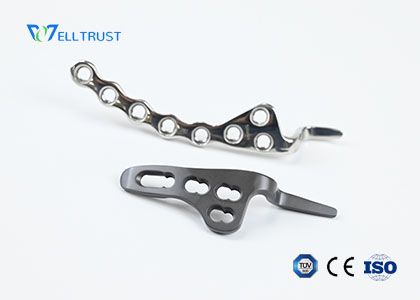
A clavicle hook locking plate is an orthopedic fixation implant for selected clavicle fracture procedures. Its configuration combines a contoured plate body with a hook extension, allowing the implant to be positioned according to the fracture pattern and the surgeon’s fixation plan. Choosing the correct version requires more than checking the plate length. Laterality, hole count, screw compatibility, dimensions, material and the available instrument set all need to be reviewed together.
A clavicle hook plate is designed to support internal fixation around the clavicle and shoulder region. The hook portion and plate body create a specific implant geometry, so the left or right version must correspond to the operative side. The plate is secured with compatible screws selected according to the available holes, bone condition and the planned fixation technique.
The Well Trust clavicle hook locking plate is identified for orthopedic trauma applications. The product configuration includes left and right options, five hole-count choices and three compatible screw categories. This gives hospitals and distributors a structured range for matching implant selection to different surgical requirements.
| Configuration | Plate dimensions | Side |
|---|---|---|
| 2 holes | 3 mm thickness × 11.5 mm width × 89 mm length | Left / Right |
| 3 holes | 3 mm thickness × 11.5 mm width × 103 mm length | Left / Right |
| 4 holes | 3 mm thickness × 11.5 mm width × 119 mm length | Left / Right |
| 5 holes | 3 mm thickness × 11.5 mm width × 134 mm length | Left / Right |
| 6 holes | 3 mm thickness × 11.5 mm width × 149 mm length | Left / Right |
The configuration range covers 2-, 3-, 4-, 5- and 6-hole plates in both left and right versions. The plate thickness and width remain consistent across the range, while the overall length changes with the number of holes. This makes hole count an important ordering detail rather than a minor packaging preference.
The clavicle hook locking plate is made from medical-grade titanium and carries CE/ISO certification information. Material selection should always be reviewed together with the implant’s technical documentation, screw system and applicable regulatory requirements for the destination market.
The compatible screw options are:
These screw categories serve different fixation requirements. The selected combination should match the plate system, the available instrumentation and the surgeon’s established technique. Screws should not be substituted solely because the diameter appears similar; thread design, head geometry and driver compatibility also need to be confirmed.
Start by confirming whether a left or right plate is required. A side-specific implant reduces ordering ambiguity and helps the surgical team prepare the correct configuration before the procedure.
Choose the number of holes and overall length according to the planned fixation construct. The available lengths range from 89 mm for the 2-hole configuration to 149 mm for the 6-hole configuration. The appropriate choice depends on the fracture pattern, available bone and the number of fixation points required by the surgical plan.
Before ordering, confirm the required locking, cortical and cancellous screws. The plate, screws, drill guides, drivers and other instruments should be treated as one compatible system.
A complete preparation process includes the appropriate plate holder, drill guide, screwdriver, measuring instruments and sterilization workflow. Product documentation should be checked for cleaning, sterilization, handling and implant identification requirements.
The clavicle hook locking plate can be evaluated alongside other fixation products according to the target anatomy and procedure. Related Well Trust resources include the Distal S-clavicle Plate, S-Clavicle Locking Plate, VA Distal Radius Locking Plate and Humeral Shaft Straight Locking Plate. The final implant choice should be made by the qualified surgical team using the patient’s anatomy, imaging and treatment plan.
A clavicle hook locking plate is an internal fixation implant with a plate body and hook extension. It is used in selected clavicle fracture procedures according to the surgeon’s treatment plan.
The available configuration includes left and right versions with 2, 3, 4, 5 or 6 holes. The dimensions are 3 mm thickness, 11.5 mm width and lengths of 89, 103, 119, 134 or 149 mm.
The plate is made from medical-grade titanium and is identified with CE/ISO certification information.
The compatible screw options include 3.5 mm locking screws, 3.5 mm cortical screws and 4.0 mm cancellous screws. The final selection must follow the matched system documentation and surgical plan.
Confirm the side, hole count, plate dimensions, compatible screw types, required instruments, product documentation and the specific requirements of the planned procedure.
This article is for product and procurement information. Implant selection, surgical technique and patient management must be determined by qualified healthcare professionals.
Tel: 86-18102187175
Whatsapp:86-18102187175
E-mail: wellortho@welltrusttech.com
Working Hours: Monday-Friday UTC+8: 9:00AM-6:00PM
Add1: 1-1301 Xindu Building, Wandezhuang Street, Wanxing Street, Nankai District, Tianjin, China
Registered address: Room 225, No.2 Huatian Rd., Huayuan Industrial Park, Binhai High-tech Zone, Tianjin, China.
Well Trust(Tianjin) Tech. Co.,Ltd