
wellortho@welltrusttech.com
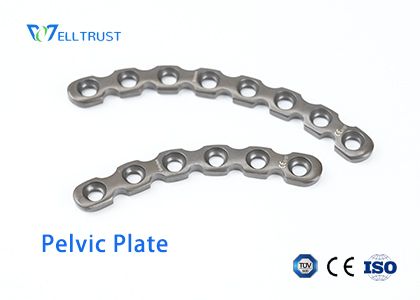
Pelvic fractures and other injuries involving the pelvic ring can require surgical stabilization when conservative treatment is not appropriate. Because the pelvis has a complex three-dimensional structure and carries substantial mechanical loads, internal fixation systems need to be selected according to the fracture pattern, anatomical location and surgical requirements. A Pelvic Plate is one of the fixation components used in orthopedic trauma procedures to help stabilize selected pelvic fractures.
Pelvic plates are shaped to follow the general contour of the pelvic anatomy and contain multiple screw holes for fixation. Different plate lengths and hole configurations allow surgeons to select an appropriate implant according to the area requiring stabilization.
A Pelvic Plate is an orthopedic fixation implant designed to provide mechanical stabilization for selected pelvic fractures. The plate is positioned along the bone and secured using compatible bone screws. Depending on the fracture configuration and surgical approach, the plate can help maintain the relationship between bone fragments during the healing process.
The curved configuration of a pelvic plate allows it to follow the contour of the target anatomical region more closely than a straight plate. The number and arrangement of screw holes determine the available fixation positions and are important considerations when selecting a plate.
The Pelvic Plate shown in the Well Trust product information is available in both stainless steel and titanium configurations, with four different plate lengths represented by the number of fixation holes.
The basic working principle of a Pelvic Plate is mechanical stabilization. After the fracture has been appropriately reduced, the plate is positioned against the bone and secured with compatible screws. The plate and screws form a fixation construct that helps maintain the selected bone alignment.
The screw holes provide locations for placing fixation screws. The number of holes can influence how many fixation points are available along the plate. A longer plate with more holes may provide additional fixation positions when the surgical plan requires a greater plate span.
Actual plate positioning, screw placement and fixation technique depend on the fracture pattern, anatomy and surgical approach and should be determined by a qualified orthopedic professional.
The pelvis has a complex anatomical shape, so fixation plates are commonly designed with contours intended to correspond to specific pelvic regions. The curved profile of a Pelvic Plate can help the implant follow the general contour of the bone.
A plate's shape and dimensions should be considered together with the intended anatomical location. In some procedures, additional contouring may be required depending on the patient's anatomy and the selected surgical technique. Any modification of an implant should follow the manufacturer's instructions and applicable surgical requirements.
The Well Trust Pelvic Plate is listed in two material configurations: stainless steel and titanium. Both are commonly used material categories for orthopedic fixation implants, although their physical and clinical characteristics differ.
Stainless steel is widely used in orthopedic instrumentation and implant applications because of its mechanical properties and established use in medical devices. Titanium and titanium alloys are also commonly used for orthopedic implants, particularly where a combination of mechanical performance and material characteristics is required.
When selecting between stainless steel and titanium, medical professionals and distributors should consider the complete fixation system, including the compatible screws, instrumentation, intended application and applicable product requirements.
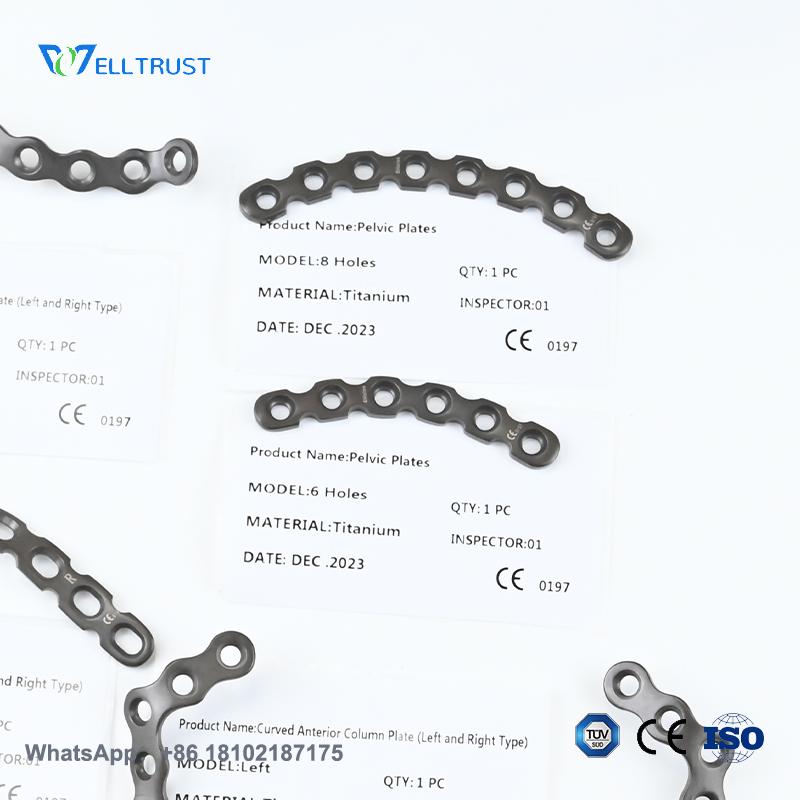
The Well Trust Pelvic Plate is offered in five hole configurations. The available product references and specifications are shown below:
| Material | REF | Specification |
|---|---|---|
| Stainless Steel | S4100-6801 | 4 holes |
| Stainless Steel | S4100-6802 | 6 holes |
| Stainless Steel | S4100-6803 | 8 holes |
| Stainless Steel | S4100-6804 | 10 holes |
| Stainless Steel | S4100-6805 | 12 holes |
| Titanium | T4100-6801 | 4 holes |
| Titanium | T4100-6802 | 6 holes |
| Titanium | T4100-6803 | 8 holes |
| Titanium | T4100-6804 | 10 holes |
| Titanium | T4100-6805 | 12 holes |
The product information specifies the use of a 4.0 mm Cannulated Screw with the Pelvic Plate. The corresponding screw and instrumentation should be selected according to the applicable fixation system and manufacturer's specifications.
The number of holes is one of the basic specifications to consider when selecting a Pelvic Plate. The four-hole configuration provides a shorter plate option, while the six-, eight-, ten- and twelve-hole configurations provide progressively more fixation positions and a longer plate span.
The appropriate configuration should be determined according to the anatomical location, fracture pattern and planned fixation points. Material selection is another consideration, with both stainless steel and titanium versions available in this product range.
Compatibility with the corresponding 4.0 mm cannulated screw is also important. The plate, screws and related instruments should be evaluated as a complete fixation system.
Well Trust supplies orthopedic implants and surgical instruments for professional orthopedic applications. The Well Trust Pelvic Plate is designed as a curved fixation plate for use in pelvic orthopedic procedures.
The product range includes stainless steel and titanium versions, with five hole configurations: 4, 6, 8, 10 and 12 holes. The stainless steel references range from S4100-6801 to S4100-6805, while the corresponding titanium references range from T4100-6801 to T4100-6805.
The Pelvic Plate is specified for use with a 4.0 mm cannulated screw. This configuration provides a coordinated plate and screw solution for appropriate pelvic fixation applications.
For orthopedic distributors and medical device companies, the availability of different materials and hole configurations provides options for building a pelvic fixation product portfolio according to different market requirements.
A Pelvic Plate is an orthopedic fixation implant designed to help stabilize selected pelvic fractures. It is secured to the bone using compatible screws after appropriate fracture reduction.
The Well Trust Pelvic Plate is available in stainless steel and titanium configurations.
The product range includes 4-hole, 6-hole, 8-hole, 10-hole and 12-hole configurations.
The product information specifies the use of a 4.0 mm cannulated screw with the Pelvic Plate. Screw selection should follow the applicable fixation system and manufacturer's specifications.
The primary difference shown in the product specifications is the number of fixation holes and corresponding plate length. The appropriate configuration depends on the intended anatomical location and surgical fixation plan.
No single plate configuration is suitable for every pelvic fracture. Selection depends on the fracture pattern, anatomical location, bone condition and surgical approach. The appropriate implant should be selected by a qualified orthopedic professional.
A Pelvic Plate is an important component of selected pelvic fracture fixation systems. Its curved configuration is designed around the general shape of the pelvic anatomy, while different hole configurations provide different fixation options.
The Well Trust Pelvic Plate is available in stainless steel and titanium versions with 4, 6, 8, 10 and 12 holes. The product information specifies compatibility with a 4.0 mm cannulated screw, allowing the plate to be incorporated into an appropriate pelvic fixation system.
By considering material, plate configuration, screw compatibility and the requirements of the intended surgical procedure, orthopedic professionals and medical device distributors can select the appropriate Pelvic Plate configuration for their specific application.
Tel: 86-18102187175
Whatsapp:86-18102187175
E-mail: wellortho@welltrusttech.com
Working Hours: Monday-Friday UTC+8: 9:00AM-6:00PM
Add1: 1-1301 Xindu Building, Wandezhuang Street, Wanxing Street, Nankai District, Tianjin, China
Registered address: Room 225, No.2 Huatian Rd., Huayuan Industrial Park, Binhai High-tech Zone, Tianjin, China.
Well Trust(Tianjin) Tech. Co.,Ltd